Rethinking Design and What 'Designer' Truly Means
Design is an important component of how we create our future yet often overlooked in terms of its impact across the generations.
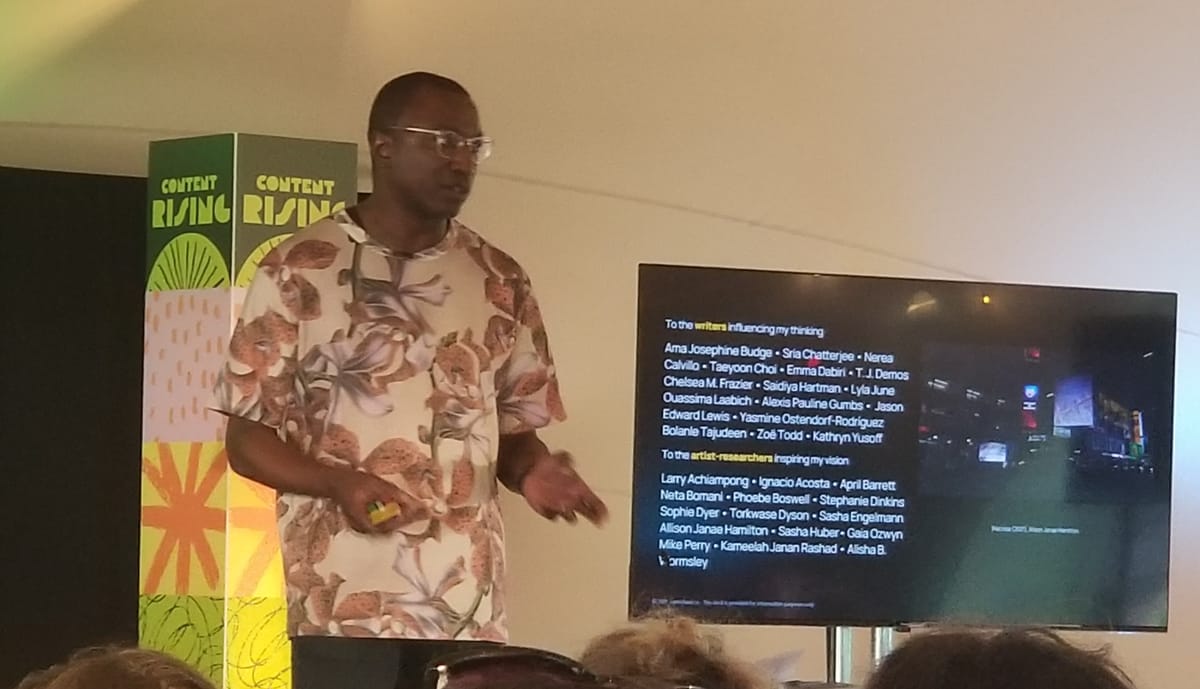
Of all the talks at Content Rising, the presentation by design researcher Michael Kibedi about Human Decentred Design prompted the deepest thinking and reflection in me.
How do we rethink technology’s relationship to the material and mineral (with its history of racial and geological traumas)?
What is recognised as design? And who are the designers?
Michael framed his talk under four headings: Soil, Self, Signals and Sky.
SOIL
Technology and industrial development has come at a price: colonial violence, increasingly harsh climates, dispossessed lands and lives. Feel the past traumas, be critical of damage and loss caused by ‘universal technology utopias’.
SELF
Look more closely at western design - have they built off African roots and aesthetic? Consider decentring the human and putting the material composition of air as the focus instead.
Humans breathe the atmosphere produced by animals, plants, bacteria and soils around us. They are part of our bloodstream. We are part of life. How might we, humanity, better contribute to that atmosphere?
Pay attention to the big and the small, said Michael.
SIGNALS
When talking about climate justice, we are also talking about housing justice, migrant justice and decolonial justice. However, “signals are distorted when the narrative of climate justice fails to engage with liberation in all its forms...”
To challenge structural power, the message of climate justice needs to be aligned with other forms of struggle: economic, housing, land and migrant, said Michael.
SKY
Narrow (western) thinking – if it overlooks other traditions - can prevent us seeing the full extent of what the relationships between humans and non-humans might be.
Look up at the sky and remember there are black people in the future... “reminding us we must never repeat the erasure or dispossession of indigenous or Black peoples.”
I told you Michael’s talk was deep.
It’s been sitting with me for almost a fortnight and it continues to swirl around my head. History is not a series of dull facts and dates. Our past can inform, advise and guide our future – and the now.
Michael reminds us that how we design is not just about the ‘look’ of things. Design must consider nature, land, soil, sea, rivers, communities, traditions, indigenous people, heritage, justice and more.
RESOURCES:
. First & Fifteenth (the biweekly newsletter by Michael Kibedi)
. Influences
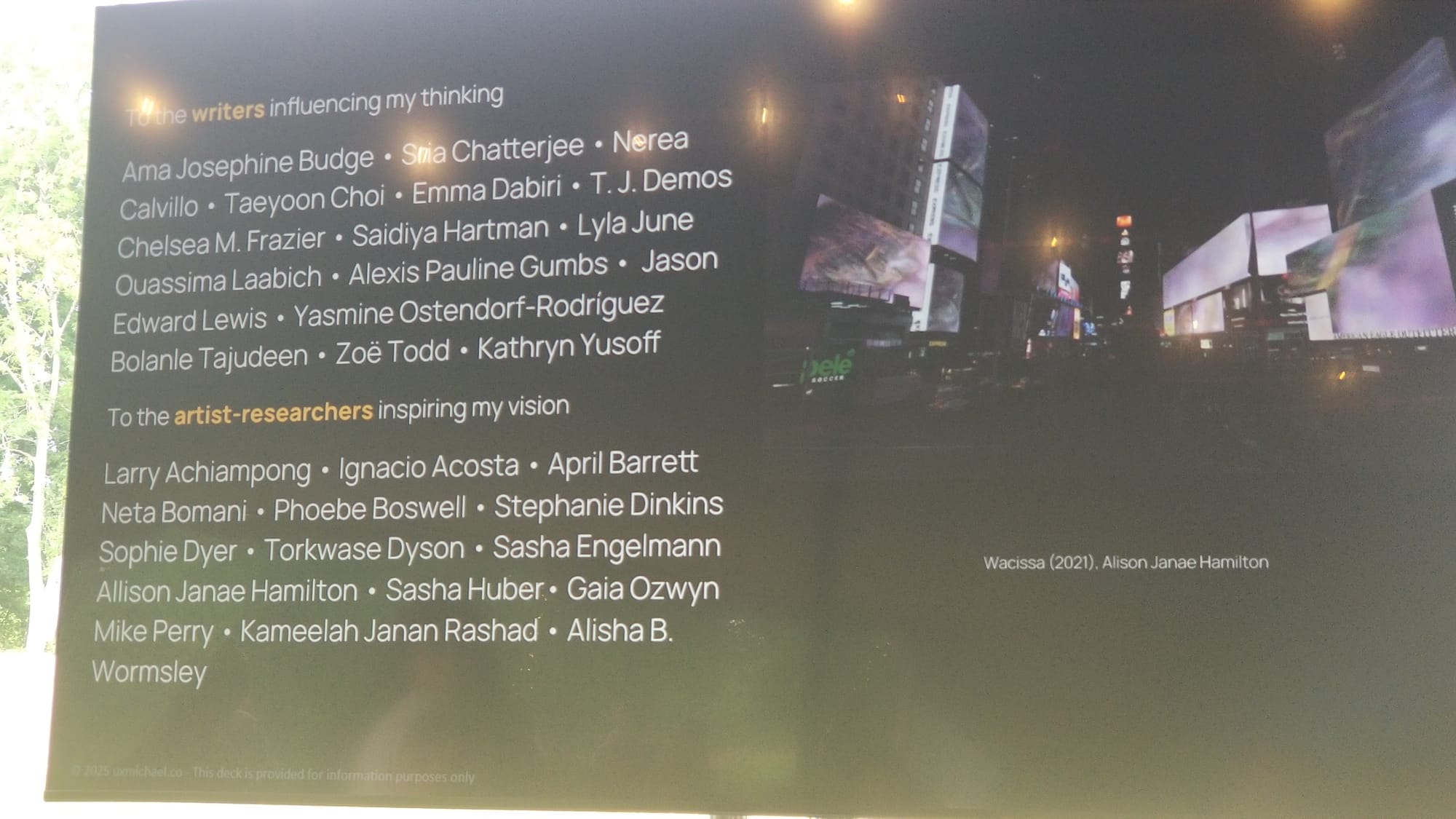
(the photo shows a presentation slide with the names of people who have influenced Michael Kibedi's research, work and writing. Michael invites you to pick a name and find out more about that person and what they have to say)
. https://www.uxmichael.co (Explore more on Michael’s website)
QUESTIONS (for reflection):
Q. How do we do design that is less extractive AND respects people and their lands?
Q. What might design (and, therefore, technology and communities) look like if we did not put the human at the centre of it?
Q. How will you reflect (and act) on Michael’s observations and findings?